Leading operations. Shipping product. Compounding both with AI.

Nine years in fintech operations. Four years shipping product. Daily orchestrating AI workflows that compound both.

Based in Costa Rica · Remote-friendly

How I work

I orchestrate AI as a senior teammate, not a magic button. My day-to-day runs on Claude Code with a stack of custom skills, persistent memory, and structured plans built for the kinds of work I actually ship.

01

The stack

Claude Code for the IDE-native loop. Custom skills loaded per session (design taste, animation, polish, accessibility, performance). MCP servers connect Supabase, Resend, design files, and live documentation. A persistent memory system holds preferences and project context across conversations. Hooks enforce house rules. Subagents fan out to handle parallel research.

Claude Code · Anthropic SDK · MCP · Custom skills · Memory · Hooks · Subagents
02

The architecture

Every project I lead has a CLAUDE.md, a playbook, and a memory file before it has a sprint plan. I work in plan mode for non-trivial tasks: structured spec, then implementation, then verification. Future-me and AI collaborators read the same documents. Both ship faster as a result.

Plan mode · CLAUDE.md · Memory schema · Verification before completion · Subagent orchestration

03

The evidence

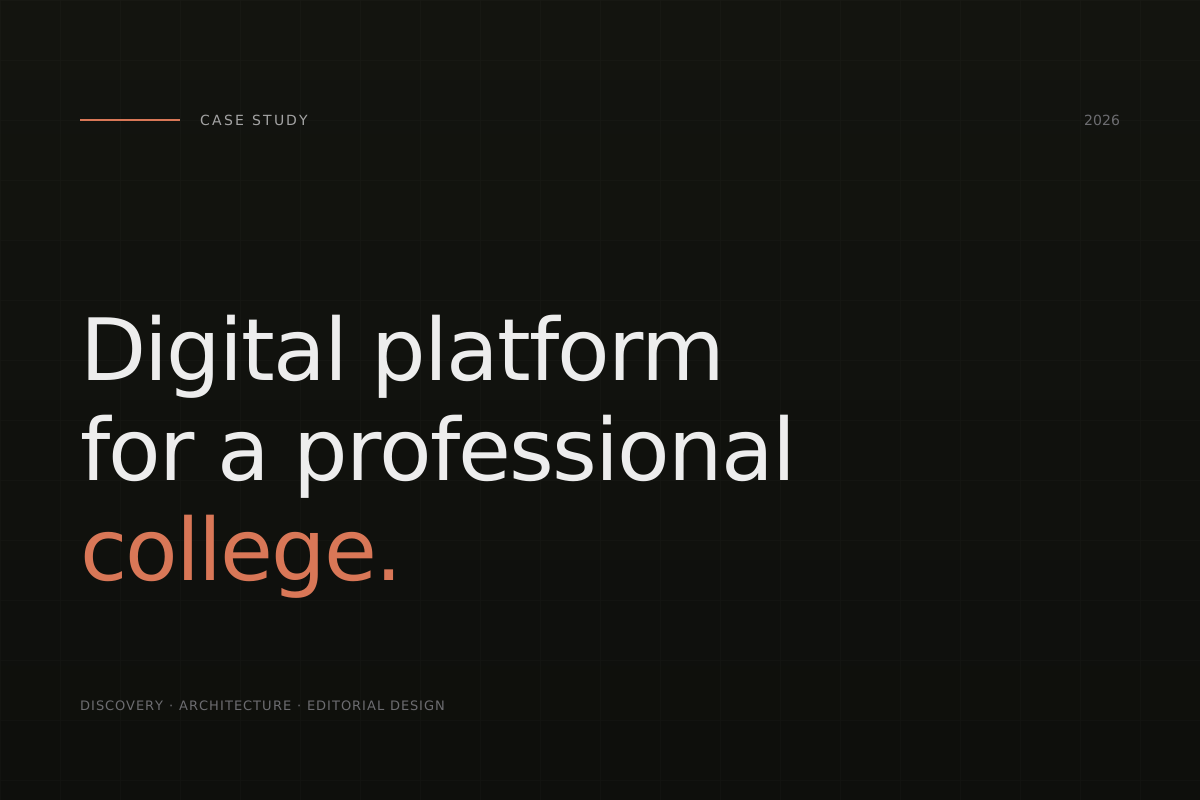
  • Editorial-grade mocks (11 screens) for a professional college client, produced in 2 sessions.
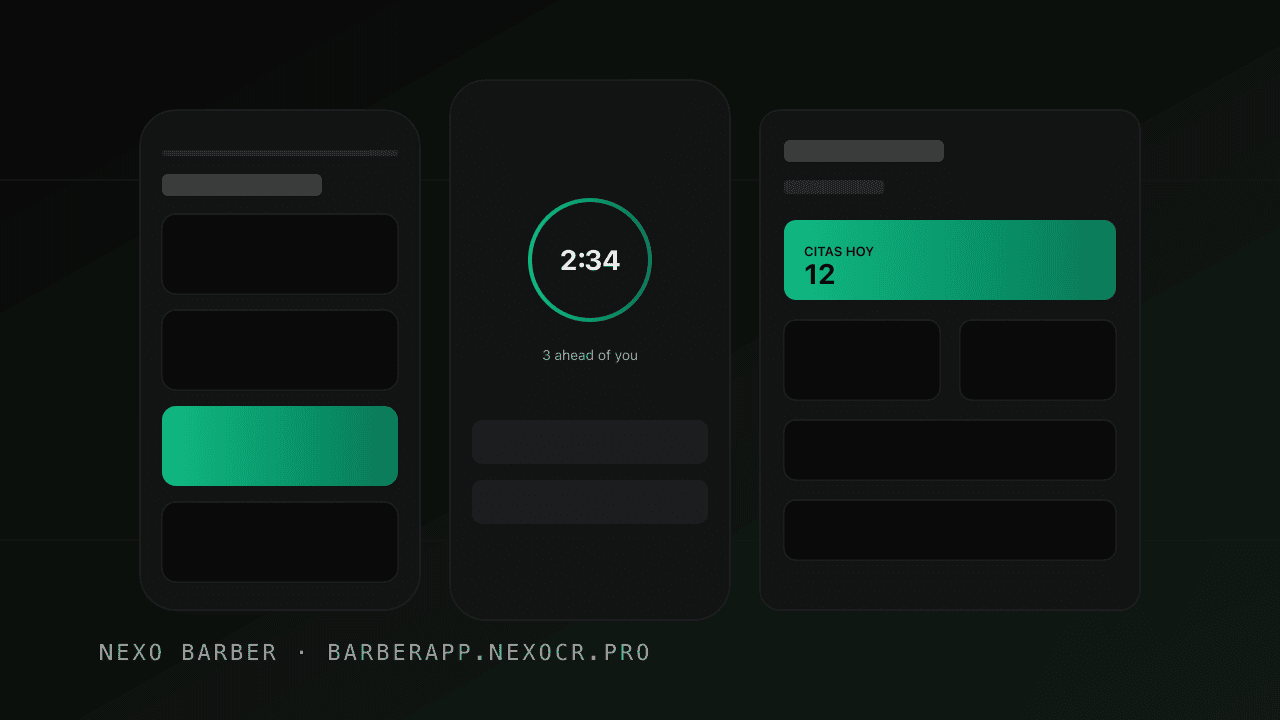
  • Nexo Barber: built end-to-end with the stack base, Supabase MCP, and a design system iterated in collaboration with AI.
  • AI workflows introduced at a Costa Rica fintech (14-person team), saving 30 to 80 hours per month.
  • This portfolio: planned in plan mode with audit, critique, and 6 GSAP modules coordinated.

See the workflow repo →

Principles

Seven rules of thumb that shape how I scope and ship. None invented; each one earned the hard way.

  1. Multi-tenant from day 1

    Every project I build starts with a businesses table and row-level security. Not because I plan to sell SaaS, but because the architectural discipline catches scope creep earlier.

  2. Risk discipline in product decisions

    Nine years of underwriting taught me the cheapest bug to fix is the one you scope out before building. I bring that filter to every product call.

  3. AI as collaborator, not replacement

    I direct AI with structure (custom skills, persistent memory, plan mode), not autopilot. The leverage compounds when you treat it as a senior teammate, not a magic button.

  4. Documentation as code

    Every project I run has a CLAUDE.md, a playbook, and a memory file before it has a sprint plan. Future-me and AI collaborators read the same documents. Both ship faster.

  5. Restraint over feature creep

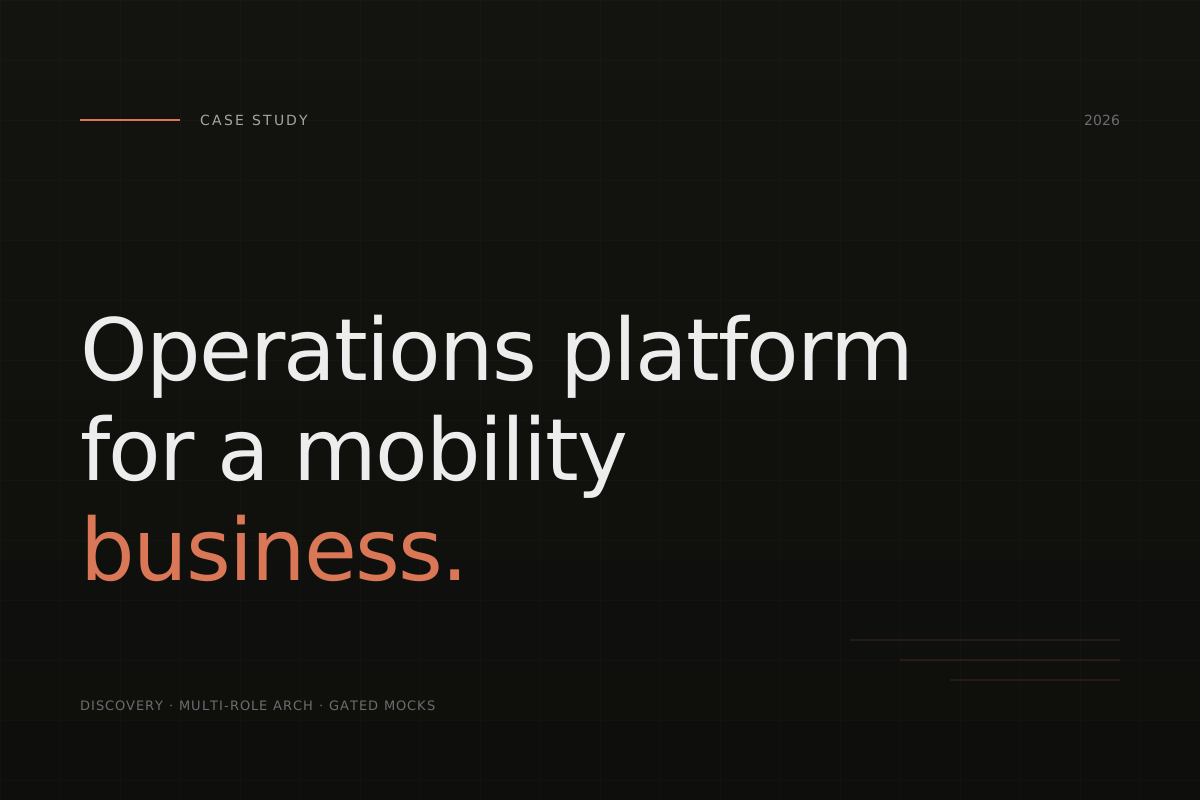
    The hardest call in product is what NOT to build. I default to fewer features done well. Mocks gated to a minimum tier unless budget justifies more.

  6. Real metrics, no vanity

    If I can’t defend a number, I don’t say it. Ranges over precision when the data is fuzzy.

  7. Boring infra, deliberate UX

    I ship on Supabase, Vercel, and Postgres because they get out of the way. The hours saved on infra go into the parts users feel.

Featured work

Other projects

View Internal HR tool · vacation tracker
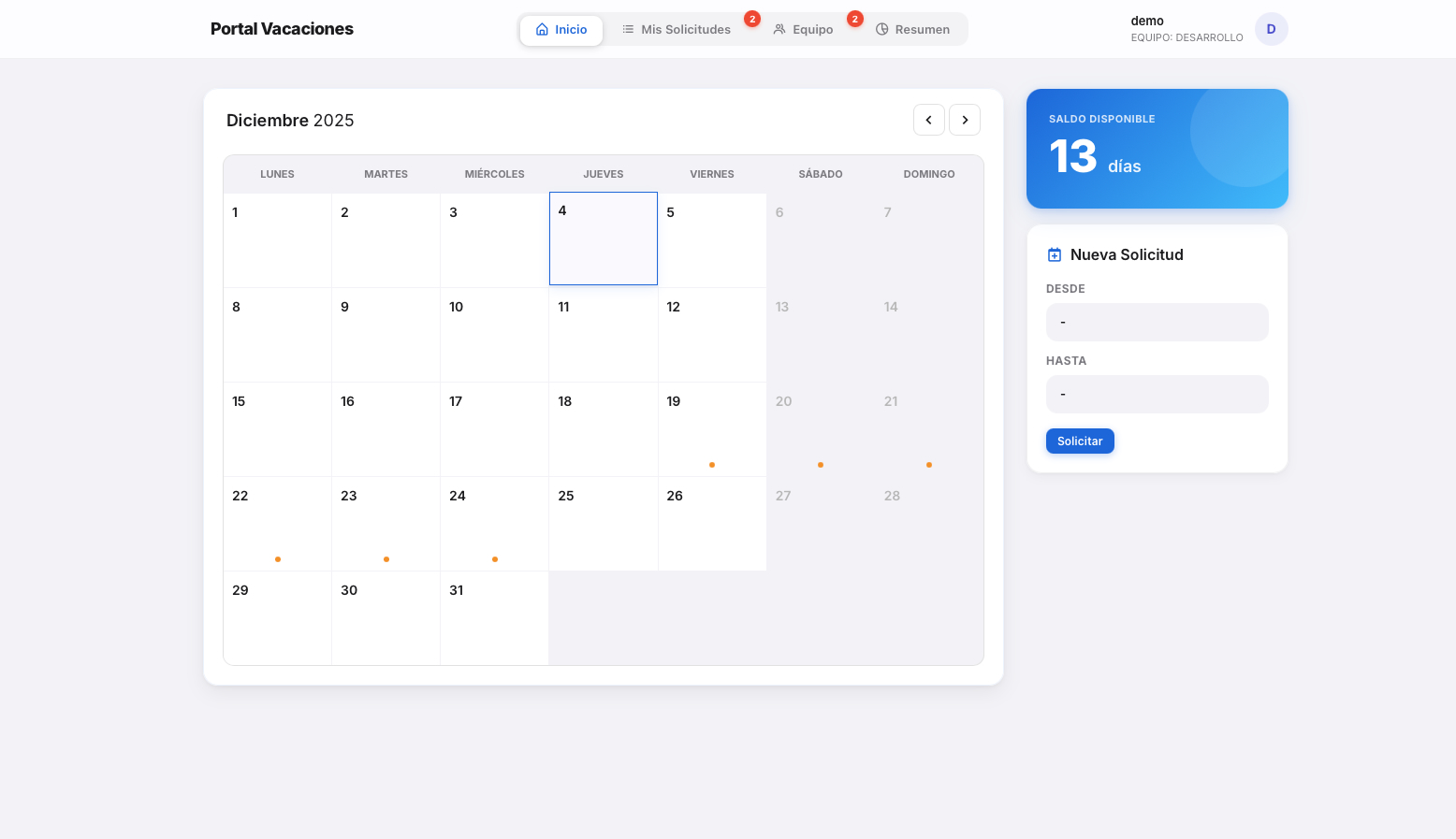
Vacation tracker web app showing a team availability calendar.

Internal tool at a Costa Rica fintech · React + Google Apps Script

Internal HR tool · vacation tracker

Serverless SPA that centralizes PTO requests, enforces blackout periods, and syncs approvals to Google Calendar. Replaced the manual email-chain process that came before it.

  • React 18
  • Google Apps Script
  • Google Sheets
View project
View SQL Data Warehouse
Medallion architecture diagram with Bronze, Silver, and Gold data layers.

Personal project · Medallion architecture

SQL Data Warehouse

End-to-end data warehouse following Bronze, Silver, and Gold layer separation. Cleaning, modeling, and analytics on top of SQL Server.

  • SQL Server
  • T-SQL
  • ETL
  • Star schema
View project

Data work

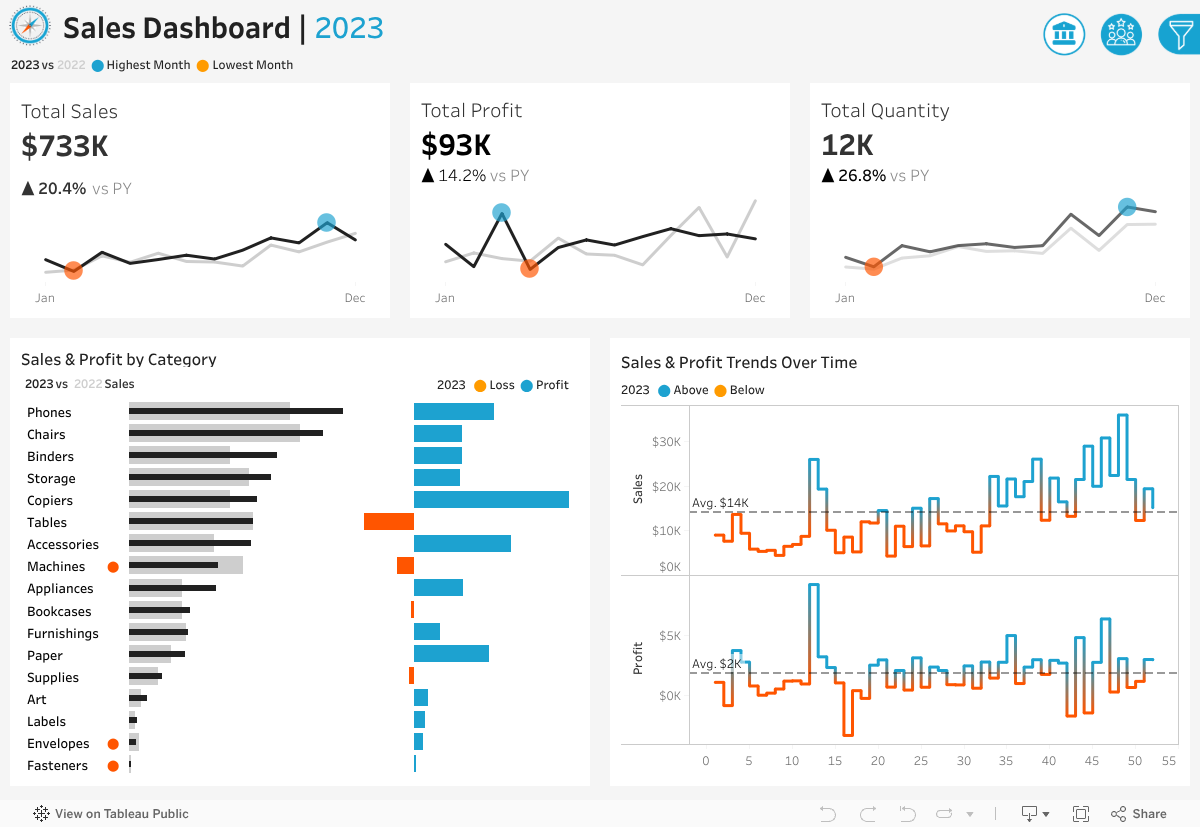
A small sample of the data side of the practice. Two Tableau Public projects, built to show what a non-technical stakeholder can diagnose on their own when the dashboard is designed for them, not for the analyst.

View HR Workforce Dashboard
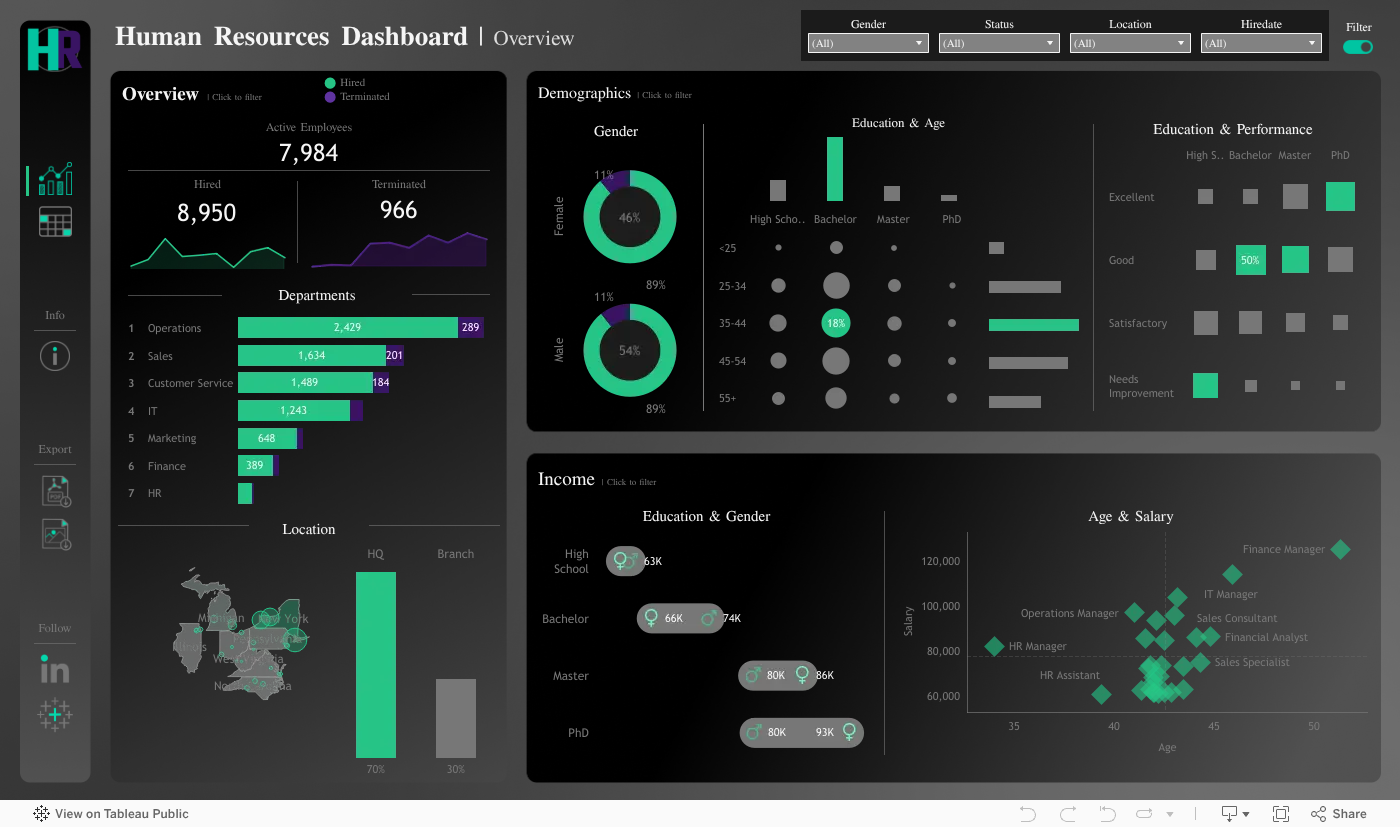
HR Summary dashboard with workforce, demographics, and income views.

Tableau Public

HR Workforce Dashboard

Three coordinated views: workforce overview, demographics, and income analysis. Cross-filtered, drill-down from KPIs to employee records.

View project
View Sales & Customer Dashboard
Sales dashboard with year-over-year revenue, profit, and retention KPIs.

Tableau Public

Sales & Customer Dashboard

Year-over-year sales and customer retention with seasonal trend isolation. Category and region filters, weekly profit averages.

View project

About

I work between business operations and engineering. The early years were underwriting and data: finding where the numbers do not add up. The recent ones added engineering. When the off-the-shelf tools could not fix the problem in front of me, I started building the ones that could.

Today I supervise a 14-person team at a Costa Rica fintech, automating validation pipelines, dashboards, and reporting. The AI workflows I introduced are in daily use across the team. On the side, I design, build, and operate Nexo Barber, a multi-tenant SaaS for barbershops shipped end-to-end in Next.js and Supabase.

Underwriting taught me to assume hostile inputs and validate everything. Product taught me to ship the smallest version that still answers the question. I move fastest when those two instincts overlap: data work that has to be defensible, internal tools that change how a team operates, and product engineering for fintech.

Nexo Barber is shipped and in steady state. I keep side projects as a personal R&D lab where I test stack patterns and AI workflows, then carry the lessons back to my main work. I look for roles where side practice is a feature, not a conflict.

What I do

01

Data engineering & analytics

SQL-first work, from raw bank statements and Salesforce exports to the dashboards senior management actually opens. Window functions, validation pipelines, risk-pattern detection on top of it.

SQL · Python · pandas · Power BI · Tableau · Excel + VBA · Salesforce

02

Product engineering

Full-stack TypeScript on Next.js 16 and React 19, backed by PostgreSQL through Supabase. I default to multi-tenant from day one, with Row-Level Security, real-time channels, and PWA install paths. Mobile-first design systems, observability through Sentry, deploys on Vercel.

TypeScript · Next.js 16 · React 19 · PostgreSQL · Supabase · TailwindCSS · Framer Motion · Vercel · Sentry

03

Operational automation & AI workflows

When the off-the-shelf tools cannot fix the problem, I build the one that can. Internal apps in Google Apps Script and React. Macros for the recurring work. AI workflows orchestrated through Claude Code, custom skills, and MCP, for the parts of the job where the leverage actually compounds. The team I supervise has these in daily use.

Claude Code · Anthropic SDK · MCP · Custom skills · Memory systems · Google Apps Script · Excel + VBA · Python

04

Underwriting & risk

Nine years underwriting merchant cash advances. Bank statement analysis, ACH and NSF pattern reading, fraud-indicator detection, pre-approval logic. The lens I carry into every product decision: assume a hostile actor on the other side of the form.

MCA underwriting · Bank statement analysis · Fraud detection · Pre-approval logic

Experience

  1. Underwriting Supervisor & Data Analyst

    Funding Metrics Sep 2021–Present

    • Built automated Tableau and Power BI dashboards consumed by senior management for real-time decision-making.
    • Aligned Salesforce data with BI dashboards to improve revenue recognition transparency.
    • Documented and escalated recurring data-quality issues through internal remediation protocols.
    • Automated underwriting and reporting workflows in Excel, VBA, and Google Sheets. Increased team efficiency by ~25%.
  2. Underwriter & Analyst

    Funding Metrics Jun 2018–Sep 2021

    • Led full underwriting for business cash advances. Analyzed financial statements, bank deposits, and credit data.
    • Strengthened fraud detection by ~25% through risk-pattern analysis and document-integrity checks.
    • Built pre-approval pipelines that streamlined the offer-generation cycle.
  3. Bank Analyst

    Funding Metrics Jun 2017–Jun 2018

    • Evaluated merchant cash flow, ACH activity, NSF frequency, and seasonality patterns.
    • Detected fraud indicators in statement formatting, deposit sequences, and balance mismatches.

Education & certifications

Universidad Hispanoamericana, Business Administration (2015–2016, Costa Rica).

  • SQL Total 2025
  • SQL desde cero a experto 2025
  • Tableau para Visualización de Datos 2024–25
  • Visualización de Datos para BI 2024–25
  • Python TOTAL: Data Science & ML 2024
  • Power BI 2024
  • Excel Intermedio-Avanzado 2024
  • Git Bootcamp 2024
  • CISCO CCNA 2023

Get in touch

Best for reaching me: email or LinkedIn. Replies within 1 to 2 business days.

Based in Costa Rica (UTC-6) · Remote-friendly across LATAM and US