Nexo Barber
A multi-tenant SaaS for independent barbershops in Costa Rica. Public booking, live queue tracking, owner dashboard, and PWA, designed and shipped end-to-end.
- Next.js 16
- React 19
- TypeScript
- Supabase (Postgres, Auth, Storage, Realtime)
- TailwindCSS v4
- Framer Motion
- Vercel
- Sentry
At a glance
Nexo Barber is a mobile-first SaaS that helps independent barbershops replace the “paper notebook + WhatsApp” workflow with a single platform: clients book online, walk-ins join a live queue, barbers see their day, and owners run the business from one dashboard. Every shop has its own subdomain, branding, schedule, and loyalty program, all powered by a multi-tenant Supabase backend.
I designed the product, built the codebase, set up the infrastructure, write the roadmap, and run customer support. The work spans the full stack: UI, design system, API, database, RLS policies, push notifications, observability, billing, and DevOps.
The problem
Independent barbershops run on a patchwork: a paper notebook for appointments, a WhatsApp group for the team, Google Calendar for the owner, and nothing at all for the client side. Bookings get double-stacked. Walk-ins get lost. Owners can’t see today’s revenue without doing math on the back of an envelope. Off-the-shelf tools (Calendly, Square) are either too expensive, too generic, or built for a different market entirely.
The bet behind Nexo: a focused product, designed for one country’s market and operating reality, that costs less than what shops already lose to a single missed booking per week.
The approach
Three audiences, one product:
- Clients book a service from a public site at
<shop>.nexocr.pro, follow a six-state live queue (countdown → “you’re next” → “your turn” → completed), and keep a profile with their history and loyalty progress. - Barbers see their day on a mobile-first “Mi día” timeline: appointments, walk-ins, and gaps, all in one column.
- Owners get a dashboard for the day, week, and month, covering revenue, no-show tracking, services, team, clients, loyalty programs, announcements, and subscription management.
Everything is mobile-first. The web app is a PWA: installable on home screens, works offline for the data already cached, and pushes notifications when a slot opens up or a turn arrives.
Architecture
A short tour of the parts that took the most thinking:
- Multi-tenant data with Row-Level Security. A single Postgres schema isolates
every shop’s data at the row level via Supabase RLS. Policies are written to
avoid self-referencing patterns, which cause infinite recursion the first time
you
JOINyour own check table. Each request runs under the user’s JWT; there is no superuser path from the client. - Subdomain routing. A Next.js middleware reads the request’s host header,
resolves it to a business, and rewrites the URL so the same App Router serves
every shop. Reserved paths (
/api,/auth,/_next,/track) bypass the subdomain rewrite to avoid breaking SSE, OAuth, and Next internals. - Real-time queue. Live tracking and the owner’s “today” view subscribe to
Supabase Realtime channels filtered by
business_id. State transitions (booked → arrived → in-service → completed) propagate to every active client in under a second. - PWA with push. A service worker manages the install prompt, offline fallbacks for the booking page, and Web Push for queue updates and reminders.
- Observability without noise. Errors are categorized at capture time: validation failures, RPC failures, expected business outcomes (rate-limited, subscription expired), and truly unexpected errors. Only the last category alerts; the rest stay in structured logs. This was the difference between “200 Sentry pings a day” and “one alert that actually matters.”
- Timezone discipline. Vercel runs in UTC. Costa Rica doesn’t. Every API route that filters by day or month computes its range using half-open UTC intervals derived from the business’s local time zone, never the server’s. CI lints for the dangerous patterns. This eliminated a class of “the 7pm appointment disappeared” bugs.
Selected features
The product is built around two audiences with very different needs: the client booking from a barbershop’s public site, and the owner running their business from one dashboard. Both views share a mobile-first design system, dark default, and the same Supabase backend.
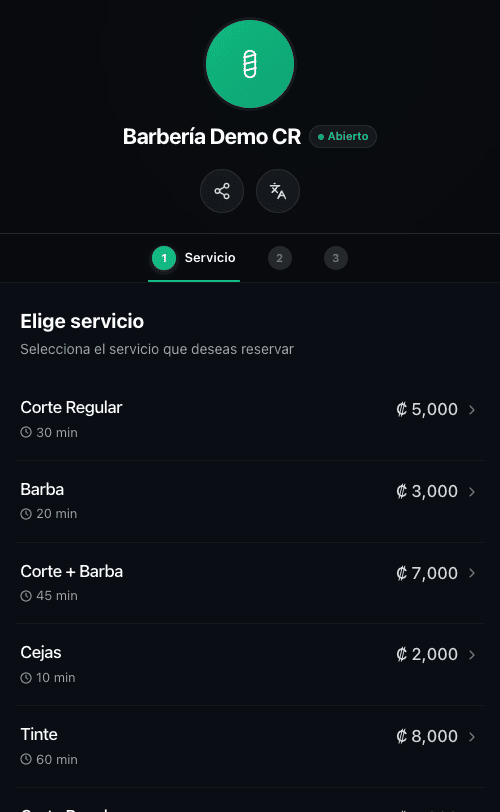
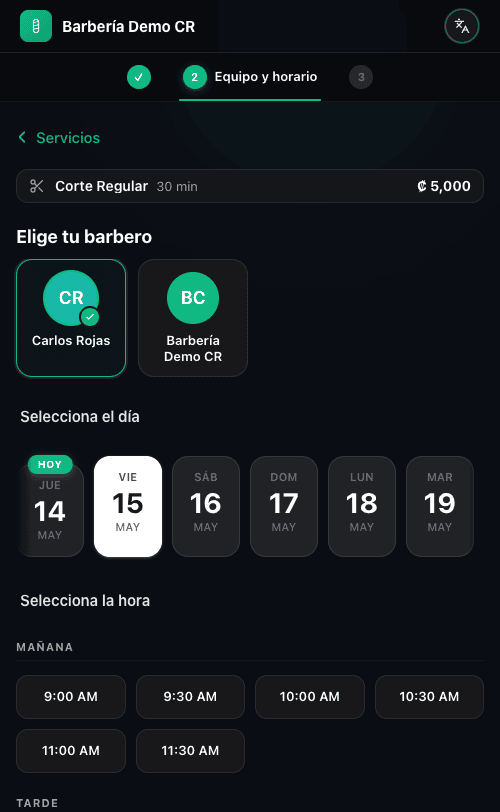
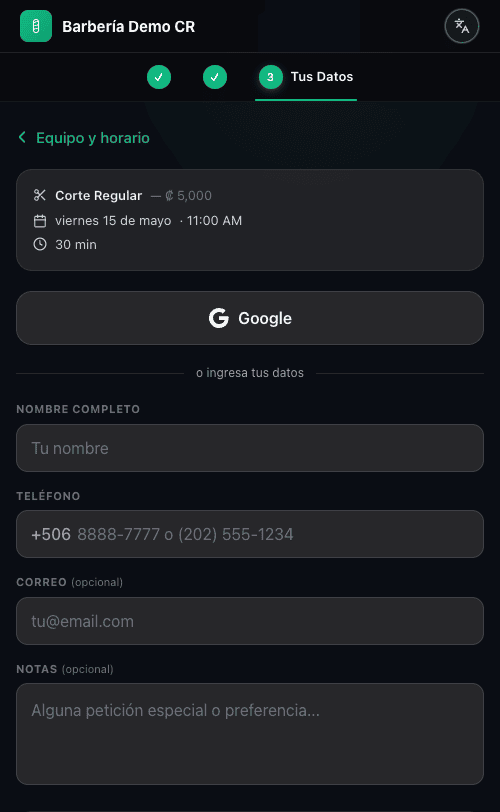
Public booking flow
Four steps, no account required to reach the end. Designed to feel as effortless as ordering food.
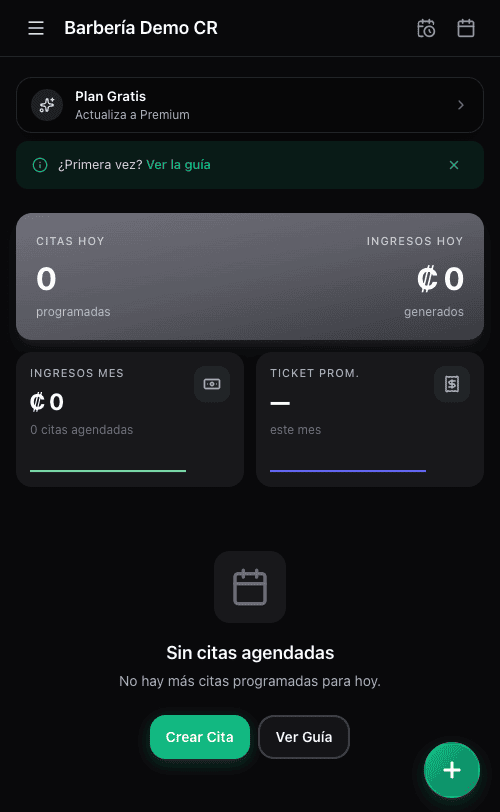
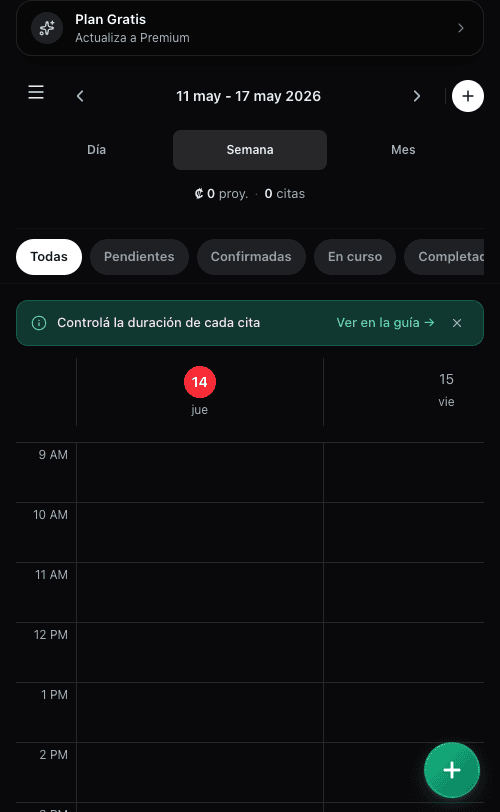
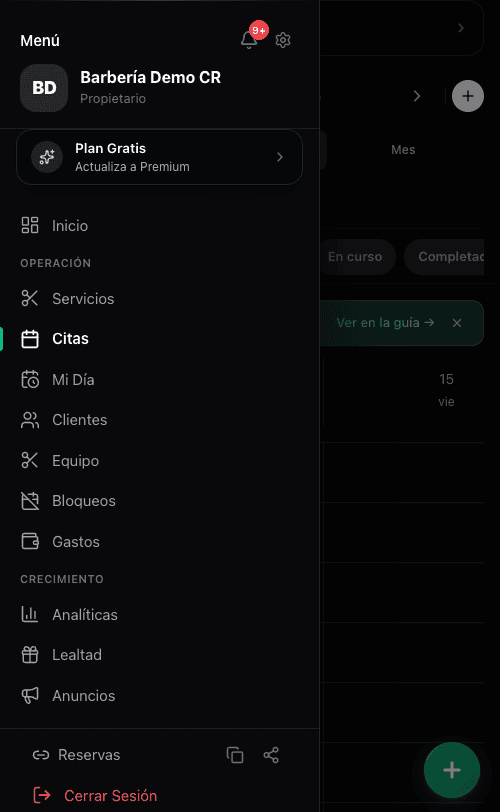
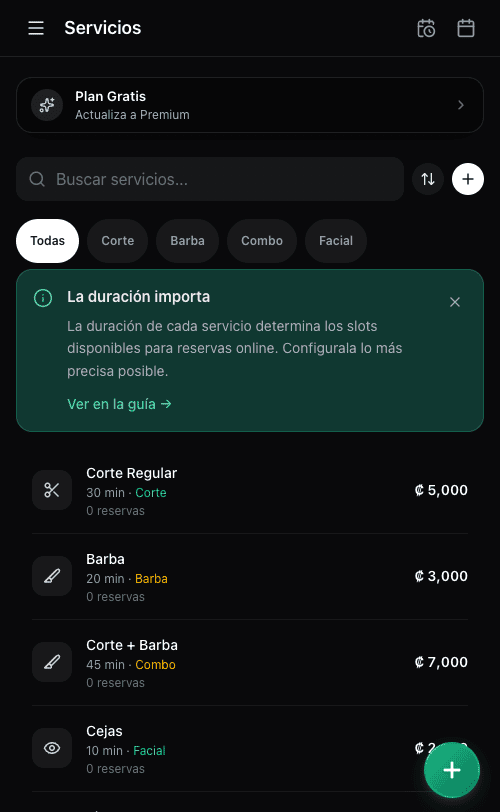
Owner workspace
Day, week, and month appointments, revenue, no-show tracking, team management, services, clients, loyalty, announcements, and subscription: all on a mobile-first layout that runs from any phone.
Decisions worth sharing
A few choices that aren’t visible from the screenshots.
01
Apple-HIG mobile baseline
44 px touch targets, bottom sheets for any overlay-like context, swipeable rows for destructive actions, a sticky two-row header on calendar views, and inline KPI text rather than card-like KPI containers. The product feels native because it picked one platform's conventions and committed.
02
Booking state restoration after OAuth
A subtle but high-traffic bug: when a user signs in mid-booking, restoring the flow has to downgrade the step if the time slot is no longer valid. The page now ships with a runtime invariant that auto-corrects mismatched state instead of rendering a blank screen.
03
Server-side enforcement of operational rules
UI-level guards aren't enough. Booking, closures, expired offers: every state transition runs through a server-side check, written assuming a hostile client.
04
CI gates for the patterns that bite
lint:tz blocks any new code that treats day/month boundaries
in server time. lint:adapter catches JSONB columns being
read without the canonical adapter. Both rules were added the day after
the bug they prevent.
What I optimize for
The product is on a budget (both money and design entropy). The constraints I hold the line on, in order:
- Mobile speed. Core Web Vitals first. The home screen and booking flow are the only routes I will accept regressions on under no circumstances.
- Multi-tenant safety. Every new feature gets reviewed for impersonation and tenant isolation. I’d rather ship a feature a week late than ship one that leaks data.
- Operator clarity. Owners are not engineers. Every screen has to make sense in three seconds, or it’s wrong.
- Design rigor. Apple-HIG is the floor, not the ceiling. The product competes with apps people already love.
Stack
- Next.js 16 (App Router)
- React 19
- TypeScript (strict)
- Supabase Postgres
- Supabase Auth
- Supabase Storage
- Supabase Realtime
- Row-Level Security
- TailwindCSS v4
- Framer Motion
- Resend (transactional email)
- Web Push (VAPID)
- Service Worker / PWA
- Vercel
- Sentry
- pino (structured logging)
- Vitest + Playwright
- Cloudflare DNS
Where to look
Live product: barberapp.nexocr.pro. Want a walkthrough or deeper technical write-up? Drop me a line at bryn.acuna7@gmail.com.